Showing posts with label native plants. Show all posts

Wednesday, May 8, 2013

Spring comes to the native riverside garden


Jack-in-the-pulpit (Arisaema triphyllum)
One year ago on May 11th I went on my first plant shopping trip with the Slow the Flow Grant money I received to completely relandscape about 4,000 square feet of bare mulch over plastic tarps we inherited when we bought our new home. One year later the plastic is gone, most of the invasive plants are gone, and the 62 varieties of native plants I planted are coming back bigger and heartier than when I bought them.

I was worried, since it was such a harsh winter, that so many things would die. And with almost two weeks now with no rain I was worried the shade plants wouldn't come back. But they are. There's nothing quite like the candy striping of the jack-in-the-pulpit (right). I never get tired of peaking under their green leaves to see this sight.


Solomon's seal (Polygonatum odoratum)

Two weeks ago a friend called and said, "remember all that solomon's seal I have in my backyard? Well, it's taking over, do you want some?" WANT SOME? Of course! My girls and I went over and dug up a whole tub of it. It's already flowering, just in time for the returning hummingbirds. Haven't seen one yet but their buffet is waiting for them.


Violets
When we moved here eighteen months ago there was one clump of violets near the driveway. Violets are a great flower to attract frittilary butterflies, and are a nectar source for early bees.  I knew if I could keep my kids from picking the flowers last spring we'd have a lot more violets. And we do! There's a nice carpet of them forming in the shade along the front fence and the front door.

The subtle globeflower (Trollius laxus) is blooming
I need more foamflower (Tiarella cordifolia). This could cover my whole yard and I'd still want more!


Trillium cuneatum
Since my plants are coming back so well I couldn't resist a little splurge last weekend at Garden in the Woods. This is my new baby, a Trillium cuneatum, not exactly native to the north shore of Massachusetts (more like NY down through the Appalachians). But it was so pretty I had to have it.

I've also purchased a few more treats this spring that I couldn't find last year. I added an American cranberry (Vaccinium macrocarpon) to the mini rain garden. And I bought a few low bush blueberries (Vaccinium angustifolium) for the future terracing in the back where I will one day add a bigger rain garden.


Miterwort or 'Fairy cup' (Mitella diphyla)
And my three and almost five-year-old garden gnomes wanted a Fairy cup plant for their fairy garden, so I gave in. I have to admit, it's a really cute plant, they have good taste. 


Tuesday, April 16, 2013

Homemade moss!

While waiting for spring to literally unfurl at our house, one fern fiddlehead at a time, I decided I wanted to finally try out a recipe for homemade moss. That's right: homemade moss. My dream is to someday have moss covering every brick and rock I used in my landscaping for last year's Slow the Flow Grant garden makeover at our riverfront property.

I tried to make moss grow years ago in indoor frog exhibits for my former job at the New England Aquarium. It was far too warm and moist and all I got was fungus. I'm willing to try again outside while the temps are still cool and we should be getting spring showers to help the moss along. It's actually a pretty simple method:
Moss: 
12 ounces beer
8 ounces plain yogurt
1 cup buttermilk
2 teaspoons sugar
1/2 cup fresh moss
Blend all ingredients in a blender until looks like, well, a moss smoothie. Then paint it on any porous surface you want moss to grow on. Keep cool and moist and in three months you should see moss growing. Since I've never tried this outside I'm not sure how long it will actually take, but I will post an update in early summer to say if it worked or not. 

The best part about making moss: I doubled the recipe and it kept my three and four year old girls occupied "painting" moss for over an hour.
They painted the bricks edging the woodland garden....

They painted the pots by the front walk...
They painted their stump chairs around the fire pit...
They even painted the trees in the fairy garden.
The only bad part about making homemade moss: because of the beer ingredient my yard smelled a little like a frat house for a few hours afterwards.

As more and more plants emerge every day I will soon know what survived the winter. Already the shoots poking out are bigger and beefier than what I planted last year! I even have a bloodroot about to flower! And I couldn't resist a trip to my favorite garden center today, I went in to buy drought-tolerant grass seed and came out with six low bush blueberries and a cranberry, two plants they didn't carry last year. Mentioning you prefer native plants at your local nursery definitely encourages them to carry more and more.


Monday, June 18, 2012

Pollination Celebration!


Gaillardia aristata, Blanket Flower
Did you know it was National Pollinator Week? I didn't either! Not until I opened up a copy of National Wildlife magazine and read a little write-up about it. According to the Pollinator Partnership website, who coordinates this international celebration:

"Five years ago the U.S. Senate’s unanimous approval and designation of the final week in June as “National Pollinator Week” marked a necessary step toward addressing the urgent issue of declining pollinator populations.  Pollinator Week has now grown to be an international celebration of the valuable ecosystem services provided by bees, birds, butterflies, bats and beetles. The growing concern for pollinators is a sign of progress, but it is vital that we continue to maximize our collective effort."
Before (http://www.ipswichareahomes.com/property/29-Upper-River-Road-Ipswich-Massachusetts)


I thought in celebration of pollination I would take a break from posts about plastic removal and compost and bring everyone some beautiful photos of what's getting pollinated in our yard. Remember, a year ago (left) none of these plants were here. To a hummingbird, bee, butterfly or moth our former yard was basically a suburban nectarless desert. Now, thanks to a little help from Slow the Flow, it's dessert! All photos are from my garden, enjoy! (click on them to enlarge)

After

Asclepias incernata, swamp milkweed in the monarch waystation about to explode in color
Ceanothus americanus, New Jersey Tea, getting ready to be in full flower. I have been desperately searching for this shrub and just found it this weekend at Garden in the Woods! Everybody should have this  in their garden: it tolerates poor, dry soil, fixes nitrogen and is a buffet for butterflies. I bought four!


Heuchera sanguinea, coral bells, blooming in the shade border
Penstemon digitalis, Beardtongue, a favorite of our
neighborhood hummingbirds

Coreopsis lanceolata "Tickseed" in the sun border
Flower stalk of foamflower, Tiarella cordifolia,
a beautiful shady groundcover.
 
Penstemon and Achillea millefolium,
common yarrow
Bee pollinating my common yarrow
Anemone canadensis, another great shade plant.

A pea flower


 And don't forget the veggie garden. I have eleven varieties of herbs growing plus flowering tomatoes, peas, squash, and pole beans. All of which are relying on pollinators to turn those blossoms into food for my family.


Even tomatoes provide food for pollinators

I hope you enjoy Pollinator Week! I just harvested my first tomato of the year, it was a great way to appreciate all the pollinators that have been hard at work in my yard.


Tuesday, June 12, 2012

The 'Woodland Island'

An old stump planted with new trillium and jack-in-the-pulpit  
I have never owned a property with shade. I've always longed after the subtle plants one sees on a woodland hike - the trilliums, wood ferns, trout lilies, wild ginger, jack-in-the-pulpits - but I've never had the shade to grow them. Until now.

I have been itching to get my hands in the dirt along the side of house where dense shade lurks. Having already planted the shade border nearer to the road I've had a chance to play around with foam flower, coral bells and solomon's seal. But the area where I've been planning my 'woodland island' is where I really get to play with native woodland plants. The path through the area will create an island of plants with a border all around it,  allowing a lot of frontage in which to display smaller, more subtle specimens that might get lost in a deeper border. 

'Before'
This area had been yet more bare mulch with an ancient yew shrub that was going (left) and a cool, old, mossy stump, which I was definitely keeping (above). It was a large area to tackle so breaking it up with an island of plants with pathways around it not only avoided a very wide border, but it allowed pathways for my kids to explore, hopefully keeping them from bushwhacking their way through the tender new plants.


Island prepped

After we removed the yew I painstakingly removed the plastic sheeting from the marked-out island area, added a bird bath and outlined the outer path (right). One of my rain barrels in also adjacent to this area and in need of an overflow solution to keep the extra water out of the basement. I plumbed the overflow line from the barrel into a pipe buried underground which drains out under the 'island', making this area slightly wetter than normal.

Finished woodland island
Before I tackled the plastic in the rest of the area I rewarded myself with a shopping trip and native planting session to finish the island (left). Species in this area include bugbane, ostrich fern, sweet pepper bush, lady fern, sensitive fern, wild ginger, trillium, foamflower and goat's beard, all plants that should not only tolerate but do well with the rain barrel overflow.

Plastic removed from the outer border of the woodland garden

Now that the island was done it was time to deal with the rest of the plastic. I brought in reinforcements in the form of two college students who made short work of the remaining sheeting (piled up to the right). It is nice to know it's no longer blocking the flow of rain into the ground. And now I was finally able to brick out the inner pathway with bricks removed from the back patio, leaving a spot for a garden bench along the right side. I only have a few unplanted plants left with which to landscape the outer border, which means one thing: another shopping trip to my favorite local nursery. Oh twist my arm!

The woodland island awaiting its woodland border


Monday, May 21, 2012

That darn plastic!


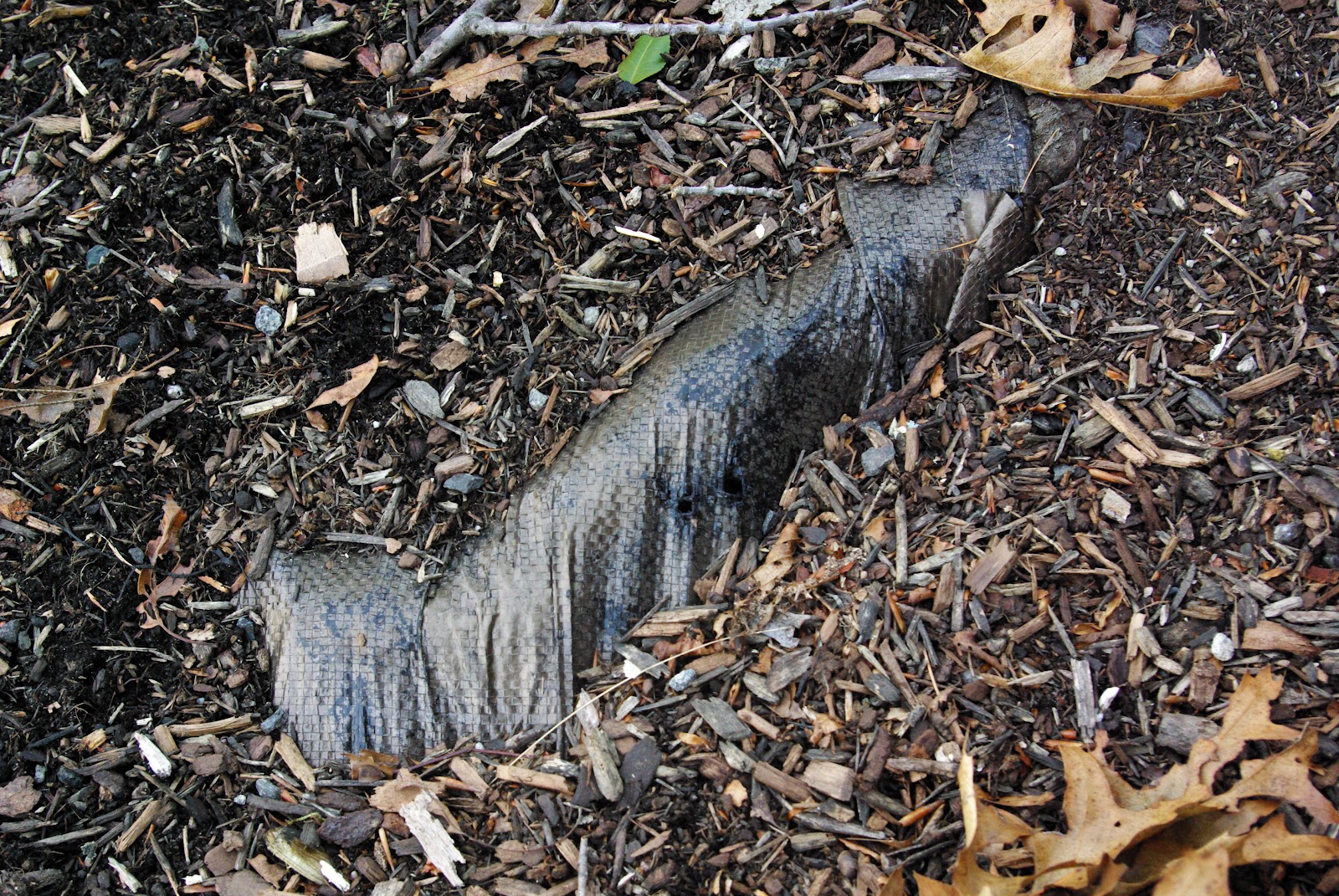
 One of the most time consuming parts of our property's native landscaping project is the removal of an estimated 2400 square feet of plastic sheeting and about 4000 square feet of plastic landscape cloth we have inherited. I could leave it in place, but if my goal is to have the new perennials and ground cover fill in nicely then the plastic and landscape cloth must be removed. Its weed-blocking days are over. Plus, having 2400 square feet of impervious plastic under the soil is a terrible thing for a river bank property. In a heavy downpour the run off will go straight into the river and not soak into the soil, adding to flash floods and droughts.

This 750 square foot section of the back yard to the right is a giant square of mulch under which is a thick plastic tarp. In some areas the tarp is buried under 10 inches of mulch, in other areas it's poking right out of the ground (above). And in other areas there's fuzzy landscape cloth over the tarp. I'm leaving this section until later in the summer having learned how much work the plastic removal is.

Last week I removed a small ten by four foot section of double-layered landscape cloth from an area along my neighbor's driveway. You can see the disturbed mulch below and the pile of landscape cloth I removed. Roots from the nearby oak tree had woven themselves right through the cloth attaching it to the mulch and making removing it extremely difficult. This small section took me over an hour.


BEFORE


After the cloth was removed I enlarged the planting area by removing about 40 square feet of lawn along this bed (future post about lawn shrinking coming). I edged the whole area with bricks dug out from an old walkway in back which we're removing. Then I rewarded myself this weekend by planting this area out with a shade garden of foam flower, coral bells, soloman's seal, bearberry, leather wood ferns, white snakeroot and a lovely variegated hosta that was already here and I divided.
AFTER


 The almost-finished area is to the right. Once I move the old yew stumps sitting by the oak, and add mulch I will declare it done! I'm looking forward to seeing the foam flower and bearberry spread and fill everything out. In future years I hope this will be a beautiful and lush section of yard.


Tuesday, May 8, 2012

0.3 acres, ancient yew shrubs, a lot of buried plastic and the PIE Slow the Flow Grant

This past October my husband and I realized a dream of buying a riverfront home. Our little 0.30 acres (see right) of Ipswich, MA sits alongside the often lazy Ipswich River, which meanders its way from its headwaters in Burlington and Wilmington, MA all the way to the Atlantic Ocean, spilling out its flow just north of Crane Beach into the Plum Island Estuary (PIE). PIE drains a 600 square kilometer area and is part of the larger Great Marsh, the largest continuous salt marsh in New England.

A very large part of this estuary is protected by the Parker River National Wildlife Refuge and local land trust. But that can't protect everything that goes into the rivers and streams that feed the wildlife refuge and salt marshes (i.e fertilizers, pesticides, and petroleum runoff). Parker River NWR announced this spring a grant program to "give impetus and incentive to property owners within the Plum Island Sound watershed to implement organic green landscaping projects in order to improve water quality and quantity of the Plum Island Estuary." They dubbed the grant "Slow the Flow".

The Ipswich River Watershed Association posted info about this grant a week before my husband and I were to appear before the Ipswich Conservation Commission to present an application to remove the old yew shrubs, relandscape with natives, and more importantly remove the 2500 square feet of plastic sheeting that I discovered the former owner's landscaper had laid down years before under about six inches of mulch to prevent weeds. It's now poking out in many places ( see left).

Being right next to the river and having plastic cover most of your yard is not a good thing. We want the watershed to hold onto runoff, not have it all dump into the river and go out to sea.  Large paved surfaces in more developed towns upstream are adding to the major flooding Ipswich has experienced in recent years. The sooner I could rip out that impervious plastic the better I would feel about myself and our owning this property.

The Conservation Commission easily granted us permission for the shrub removal, addition of a native wildlife garden (where there is otherwise just bare mulch), a vegetable garden, shrinking the lawn and installing a safety fence in a small area of the backyard so my two very young children didn't end up in the river. The next day I immediately started digging. If you can imagine my goal of native cottage and woodland gardens, with colorful perennials and ferns, and you look below to see what I had to start with you can see why I started digging right away. My vision is pretty much the antithesis of this picture.


Even with Conservation's approval in hand I thought it would be a long shot to get this grant. It could mean a matching award towards all the ferns, jack-in-the-pulpits, foam flowers, cardinal flowers, fothergillas and blueberries I had been dreaming about all winter. In the four months we had owned the house we had spent a lot of money on insulation (it had almost none) and other energy upgrades which were a priority, not leaving much in my dream garden budget. The grant would allow more of all these plants and larger specimens too. Instead of planting over four or five years I could afford to fill in the bare areas this year. I attended the workshop in March, listened to many great lectures on research going on in PIE that I wasn't aware about, and native gardening tips that I were aware about but was happy to hear again. I sent my application in on April 18th and crossed my fingers.

In the meantime my husband ripped out all the yews (as much as I despise destroying any plant, I couldn't find a home for the yews and they sadly ended up at the local leaf dump). For a few weeks it looked like a tornado hit the house. I made many promises to neighbors that "it will look better some day, I promise!" As the new green color went on the clapboard, the doors were redressed in a bright blue and the stucco lightened I think the neighbors began to believe me. And while awaiting word on the Slow the Flow grant I kept busy filling in the otherwise empty and desert-like strip of mulch along the road (foreground to the left), and the now-empty space by the front door, with blanket flowers, liatris, black eyed susans, columbines, coneflowers, ferns, and day lilies I started in my greenhouse - and a pussy willow my three-year-old picked out at a local nursery.

On rainy days my girls helped me make mosaic bird baths that are to become focal points in each of the garden areas. Although I keep finding their plastic toy lizards in them, they're also very good at making sure the bird baths are supplied with water from the two rainbarrels I just installed. I have had eleven neighbors stop to tell me just this week that "WOW, what a difference!" or ask "May I come back and write down what these plants are?"

And then I came home last Thursday night to an email stating I got the grant! I could not have been more thrilled. Some women indulge themselves buying shoes, or jewelery or clothes. I buy plants. You can never have too many books or flowers I always say. So this weekend's plan is to hit the local nurseries and next week's plan is a trip with my older daughter to Garden in the Woods, home of the New England Wildflower Society and the mecca of native woodland plants.

A big thank you to the team at Parker River NWR for awarding me this grant and beginning what I know is going to be a rewarding and beautiful journey for our family and our new home. I will post pics every week on my progress and look forward to sharing the results.